
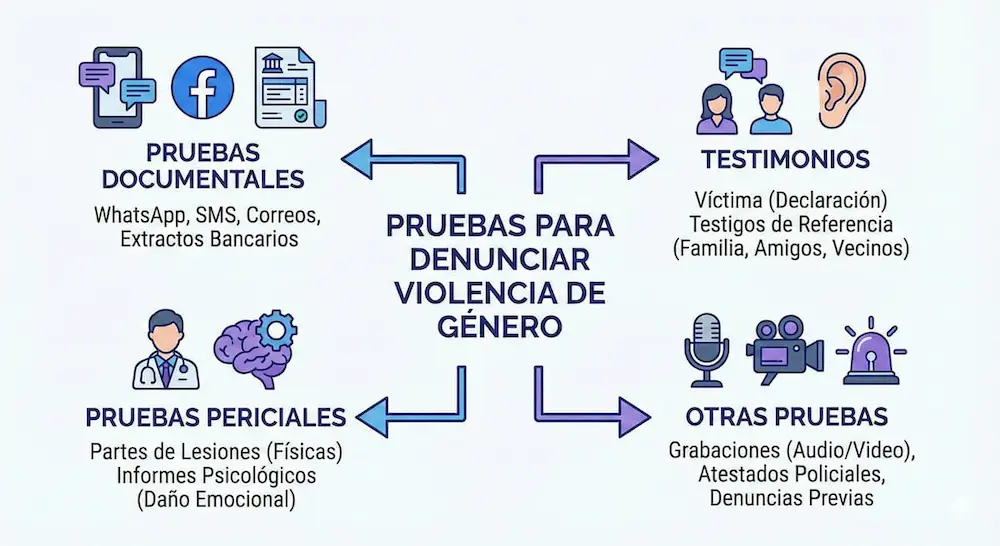
HOW TO PROVE THAT YOU ARE A VICTIM OF GENDER-BASED VIOLENCE: A GUIDE TO EVIDENCE
There is a very common fear among women going through an abusive situation: thinking that if they do not have physical marks on their body, the judge will not believe them. Often, silence and the lack of “direct witnesses” create the feeling that it is her word against his. However, there is a fundamental legal detail that most people are unaware of, which can completely change the course of a criminal complaint. This detail does not involve having a camera recording 24 hours a day, but rather how the Spanish justice system evaluates a woman’s testimony and what small, invisible tracks the abuser leaves behind in daily life. If you stay until the end, you will understand why those WhatsApp messages you deleted out of fear, or that doctor’s visit that seemed insignificant to you, are actually the keys to your freedom.
THE VALUE OF THE VICTIM’S TESTIMONY AS THE PRIMARY EVIDENCE
In cases of gender-based violence, most assaults occur within the privacy of the home, with no one else present. For this reason, the law and the Supreme Court in Spain have established that a woman’s statement can be sufficient evidence to convict the aggressor, even if there is no other direct evidence. This is because, otherwise, most crimes of this nature would go unpunished.
For your word to hold this value as “prosecution evidence” (prueba de cargo), judges typically look at three key requirements. The first is the absence of subjective incredibility. This means the judge analyzes whether you have any motive involving revenge or resentment that might drive you to lie. It is not about you not being angry (it is natural to be so), but rather that your intention is to seek justice and not simply to cause harm gratuitously. The second point is the veracity of the testimony, meaning that your story is logical and remains consistent over time. The third point is persistence in the incrimination: if you tell the same story to the police, before the judge, and on the day of the trial, your testimony gains immense strength.
It is important to understand that you do not need to be a legal expert to testify. What is sought is the truth of what was experienced. Your narrative is the common thread that connects all the other pieces of the puzzle that we will look at below.
DOCUMENTARY EVIDENCE AND TEXT MESSAGES
Today, we carry highly valuable evidence right in our pockets: our mobile phones. WhatsApp conversations, text messages, emails, and social media messages are fundamental. Many women are tempted to delete these messages because it hurts to read them or because they fear the aggressor might see them. However, those messages are a snapshot of reality.
When we talk about messages, we are not just referring to direct insults or threats. Control messages are also highly important, such as those where he demands to know where you are every single minute, forbids you from going out with friends, or reproaches you for how you are dressed. These messages demonstrate a relationship of power and submission, which constitutes the very foundation of gender-based violence.
For these messages to be useful in a trial, it is vital not to tamper with them. Do not take screenshots and then delete the original message. The ideal approach is to preserve the phone and the complete conversation. If you are afraid of losing them, there are applications and legal services that allow you to certify these conversations so they hold legal validity. Furthermore, if he sends you voice notes, guard them like gold. The voice is biometric evidence that is very difficult to deny, and it conveys the tone of aggression that text sometimes fails to reflect.
THE INJURY REPORT AND MEDICAL REPORTS
The injury report (parte de lesiones) is probably the most widely known physical evidence, but it is often incompletely understood. You do not need to have a broken bone or a black eye to go to the emergency room or your local health center. Scratches, hair-pulling that leaves the scalp sore, squeezing of the arms that leaves minor marks, or even internal pain from being pushed are all injuries.
When you see a doctor, it is fundamental that you tell the truth about the origin of those injuries. If you state that you fell down the stairs, the doctor will write that down, and it will be very difficult to change it later. Healthcare professionals are legally obligated to activate a gender-based violence protocol if they suspect that the injuries do not match your explanation or if you confess to them what happened.
This medical document is sent directly to the court and becomes objective, impartial evidence. The doctor is neither on your side nor on his; the doctor simply describes what they observe on your body. Moreover, medical reports are not only useful for physical violence. If you suffer from anxiety, insomnia, weight loss, or panic attacks due to the situation you are living in, those reports from your GP or mental health professional are crucial evidence of the psychological violence you are enduring.
THE IMPORTANCE OF EXPERT PSYCHOLOGICAL REPORTS
Psychological violence is the hardest to see with the naked eye, but it is often what causes the most long-term damage. Since it leaves no scars on the skin, it is proven through expert psychological evaluations (peritajes psicológicos). These reports are conducted by specialized psychologists who evaluate your emotional state and look for symptoms compatible with abuse, such as Post-Traumatic Stress Disorder (PTSD).
A forensic psychologist or an expert from the Comprehensive Forensic Evaluation Units (Unidades de Valoración Forense Integral) will analyze your behavior, how you recount the events, and the psychological sequelae you suffer from. These professionals know how to detect when a person is experiencing the consequences of living in an environment of fear and control. It is very difficult to fake these symptoms consistently over time, which is why these reports carry great weight with judges.
Even if you have never been to a psychologist, the court can order an evaluation. This assessment is not to check if you are “crazy,” but rather to measure the impact that your partner’s or ex-partner’s behavior has had on your mental health. It is a way of “making the invisible visible.”
HEARSAY WITNESSES AND THE SOCIAL ENVIRONMENT
Often, victims say: “Nobody saw us, we were alone.” It is true that abusers are usually very careful not to act in front of others. However, there are what the law calls “hearsay witnesses” (testigos de referencia). These are the people you told about what happened immediately after it occurred, who saw you crying, or who noticed how your personality changed over time.
Your mother, your best friend, a coworker who saw you arrive nervous, or the neighbor who heard shouting through the wall are all valid witnesses. Their statements serve to corroborate your story. For example, if a friend testifies that you called her crying one night saying he had pushed you, that serves to support your primary testimony.
It is important not to ask anyone to lie. The strength of a witness lies in their sincerity. If a neighbor says, “I didn’t see the blow, but I heard constant insults and furniture breaking every night,” that is powerful evidence of an environment of habitual abuse. Abuse is not just an isolated event; it is a climate of constant fear, and your social circle is the best thermometer to measure that climate.
EVIDENCE OF ECONOMIC VIOLENCE AND ISOLATION
Gender-based violence also manifests through financial control and social isolation. If he prevents you from working, controls every penny you spend and demands supermarket receipts, or has left you without access to joint bank accounts, you are facing economic violence.
To prove this, you can provide bank statements showing that you have no transactions or that he withdraws all the money. Emails where he reproaches you for a minimal expense, or testimonies from people who know you lacked the freedom to buy even personal hygiene products without his permission, are also useful.
Regarding isolation, it can be proven if he forced you to block family members on your phone or caused fights with everyone around you so that you would stop seeing them. Call logs showing that you suddenly stopped speaking to your family, or messages where he insults you for wanting to go visit your parents, are evidence of how a network was woven to leave you isolated and vulnerable.
AUDIO AND VIDEO RECORDINGS: ARE THEY LEGAL?
This is one of the questions we receive most frequently at the firm. Can I record my husband while he insults or threatens me inside the house? The short answer is yes, provided that you are a participant in that conversation. In Spain, recording a conversation in which you are a party is not a crime against privacy, even if it is done without the other person’s consent.
What you cannot do is place a hidden microphone and leave the room to record what he says when you are not there. But if he starts shouting at or threatening you and you activate your phone’s recorder, that audio can be admitted as evidence in court. These recordings are very useful because they capture the real aggression, the threatening tone of voice, and the exact words used.
An important recommendation: try not to provoke him into saying something. What holds value is the spontaneous recording of his habitual behavior. Once you have the recording, do not edit or cut it; submit it in full so that the context of the situation can be seen.
THE IMPORTANCE OF THE POLICE REPORT
When you decide to call the police during a crisis, the officers draft a document called a police report (atestado). In this document, the police describe what they found upon arriving at the house: if there was broken furniture, if you were shaking or crying, if he was aggressive, or if his knuckles were red.
Even if at that moment you are so afraid that you decide not to file a formal complaint, the fact that the police went to your home already leaves an official trail. That police report is filed away and can be retrieved months later if you finally decide to take the step. Police officers are privileged witnesses because they see the scene “in the heat of the moment,” and their notes regarding your emotional state and the disarray of the home are pieces of evidence that are very difficult for the aggressor to refute.
HOW TO ACT IF YOU HAVE NO PHYSICAL EVIDENCE
If, after reading all of this, you feel like you have nothing (no messages, no photos, no medical reports), do not despair. Many convictions for gender-based violence are based on reconstructing the facts through the victim’s testimony and expert assessments.
The first step is to start building that trail from now on. You can begin writing down the days and times when incidents occur in a notebook (one that he cannot find) or in a hidden note on your phone, describing what happened. You can talk to someone you trust so they know what you are going through; that person will become your hearsay witness.
Additionally, remember that the judicial system has specialized psychologists and social workers whose specific role is to detect situations of abuse where there is no obvious external evidence. Your own story, told with coherence and detail, is the engine that sets the entire protection machinery in motion.
THE ROLE OF THE DEFENSE LAWYER IN GATHERING EVIDENCE
Having a lawyer who specializes in gender-based violence from the very beginning is fundamental. Our job is not only to represent you in court, but to help you identify which things you have at home or on your phone are actually useful evidence. Sometimes, something that seems silly to you is, for us, the key to proving a threat or abusive control.
Your lawyer will help you organize messages, request the necessary medical reports, and prepare your statement so that you feel secure. They will also handle requesting protection measures, such as a restraining order, using the evidence you have gathered together. You are not alone in this process; the goal is to transform your experience into a solid case file that the judge cannot ignore.
FREQUENTLY ASKED QUESTIONS ABOUT EVIDENCE IN GENDER-BASED VIOLENCE
Are WhatsApp messages useful if he deleted them from his phone? Yes, what matters is that you preserve them on your device. Even if he deletes them from his phone, if you have them, you can present them. Ideally, you should not delete the conversation or the contact so that it can be verified that the phone number from which they were sent belongs to him.
Can I file a complaint if the insults occurred months ago and I have no marks? Of course. Gender-based violence does not statute-bar immediately, and insults or demeaning treatment are offenses even if they leave no physical mark. In these cases, your testimony and that of people who knew you were suffering at that time are used, along with any messages or emails you kept from that period.
What happens if my family does not want to testify because they are afraid of him? This is a common situation. Although they cannot be forced to testify enthusiastically, there are other ways to prove the facts. Reports from social services, forensic psychological assessments, and testimonies from professionals (such as your doctor or your children’s teacher) can make up for the lack of family witnesses.
Do photos of bruises count if I didn’t go to the doctor at the time? They serve as circumstantial evidence (indicio), but they carry less weight than an official medical report because it is harder to prove when and how they occurred. Nonetheless, if you have those photos, save them and show them to your lawyer. Furthermore, if those photos were sent via WhatsApp to someone at the time, the date of transmission helps place them chronologically.
Can my children be taken away from me if I don’t have enough evidence of the abuse? This is one of the greatest fears, but the law protects minors. The fact that a woman faces difficulties in proving a specific episode of abuse does not mean she is a bad mother. On the contrary, the judicial system seeks to protect children from violent environments. The important thing is to get proper legal advice to present the situation in a way that prioritizes the well-being of the minors.
This post is also available in: