



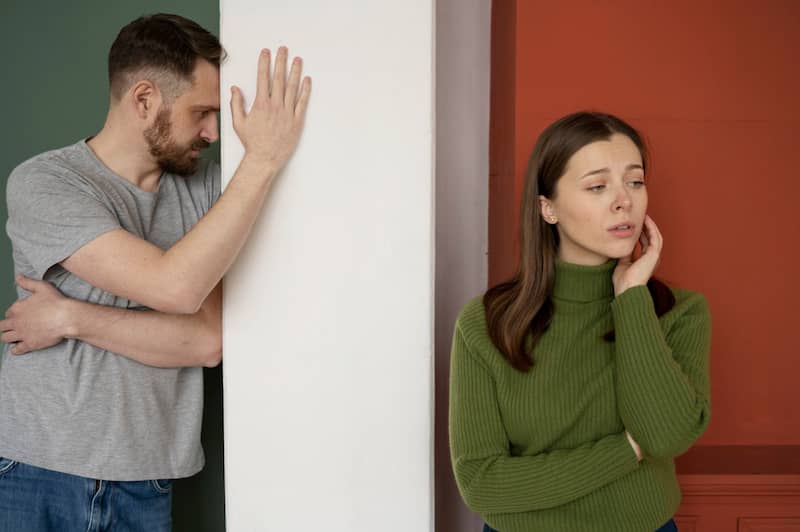
Post-separation harassment is the pursuit, surveillance or persistent contact that some ex-partners keep up after the break-up, in person, on social media or through the children. It is the offence of harassment or stalking (art. 172 ter of the Criminal Code) and, when the victim is the ex-partner, it is punishable by one to two years in prison or community service, and it is prosecuted without the victim needing to file a complaint.
Separation should be the end of a relationship, but for many women it is the beginning of another form of control: calls at all hours, “chance” appearances at work, messages from new profiles, or collecting the children turned into an interrogation. Because there are not always explicit threats or blows, it is often played down. However, the law punishes it and there are effective tools to stop it.
Why harassment after a break-up is so serious
The break-up is a time of particular risk. According to the statistical sheet of the Government Delegation against Gender Violence (Delegación del Gobierno contra la Violencia de Género), updated to 29 September 2026, 23 of the 41 women killed by gender violence in 2026 (56.1 %) were killed by their ex-partner or by a partner in the process of breaking up. Persistent harassment is often a sign that the abuser does not accept the separation. We explain this in our article on femicide: figures, causes and how to prevent it.
Besides the physical risk, continued harassment causes anxiety, insomnia, isolation and the feeling that you cannot rebuild your life, effects which are also legally relevant.
The offence of harassment or stalking (art. 172 ter CP)
This offence is committed by anyone who harasses another person insistently and repeatedly, without lawful authorisation, thereby disrupting the normal course of their daily life, through any of the following behaviours:
- Watching her, following her or seeking physical proximity to her.
- Establishing or trying to establish contact with her by any means of communication or through third parties.
- Misusing her personal data to buy products, take out services or cause third parties to contact her.
- Interfering with her freedom or her property, or those of someone close to her.
| Scenario | Penalty |
|---|---|
| Basic harassment (art. 172 ter.1) | 3 months to 2 years in prison or a fine of 6 to 24 months |
| Particularly vulnerable victim | 6 months to 2 years in prison |
| Victim who is or was a partner, or another person listed in art. 173.2 (art. 172 ter.2) | 1 to 2 years in prison or 60 to 120 days of community service |
| Using someone’s image without consent to create fake adverts or profiles that cause them harassment or humiliation (art. 172 ter.5) | 3 months to 1 year in prison or a fine of 6 to 12 months |
Two important details. First, basic harassment requires a complaint from the victim, but when the victim is the partner or ex-partner, no complaint is needed (art. 172 ter.2). Second, these penalties are added to those for any other offences that the acts of harassment amount to, such as threats, coercion or criminal damage (art. 172 ter.3).
When the victim is the ex-partner, these acts are investigated by the Violence against Women Section of the Court of First Instance (Sección de Violencia sobre la Mujer del Tribunal de Instancia, formerly the Violence against Women Court).
Common forms of harassment after separation
Through the children
This is one of the most damaging forms and one of the hardest to detect: using handovers to argue or keep watch, questioning the children about their mother’s life, sending messages through them, ignoring agreed times to unsettle you, or threatening to “take the children away from you”. When the aim is to harm the mother through the children, it may amount to vicarious violence. We explain this in vicarious violence: what it is, how it affects you and how to defend yourself.
The law offers protection in the civil sphere: since Organic Law 8/2021, article 92.7 of the Civil Code (Código Civil) rules out shared custody when one parent is facing criminal proceedings for an attack on the other parent or the children, or when there are well-founded indications of domestic or gender violence. In those same cases, article 94 prevents a contact arrangement from being established, or suspends it if one already existed, unless the judge orders it in a reasoned decision based on the best interests of the child. In addition, article 66 of Organic Law 1/2004 allows the judge to suspend contact. A Draft Organic Law on measures concerning vicarious violence is going through Parliament (Congreso), but it is not yet in force.
On social media and digital channels
- Constant messages from new numbers or profiles after being blocked.
- Monitoring your location or your social media, and comments to your friends.
- Fake profiles using your image or adverts with your details (art. 172 ter.5).
- Sharing intimate images obtained during the relationship, which is an offence against privacy (art. 197.7 CP).
If the harassment is mainly digital, see our cyberviolence and online harassment service.
In person and through third parties
Waiting for you outside work or school, walking past your home, messages or errands passed on through relatives and mutual friends, or turning up where you exercise. Although each incident on its own may seem minor, it is the repetition that makes it an offence.
Important: if there is already a restraining order (orden de alejamiento) or a ban on communication, any contact or approach is also the offence of breach of a court order (art. 468.2 CP), punishable by six months to one year in prison. And if the abuser tampers with or removes the electronic monitoring bracelet, he commits a further offence (art. 468.3 CP). Tell the police as soon as it happens.
How to document it
Harassment is proven by accumulation. The better you record the repetition, the easier it will be to prove that it disrupts your daily life:
- Chronological log: date, time, place, what happened, who saw it. Keep it somewhere safe, away from devices he could access.
- Full screenshots of missed calls, messages, emails and posts, showing the sender and the date. Do not delete the original conversations.
- Witnesses: work colleagues, neighbours or relatives who have seen him waiting or received his messages.
- Cameras: ask early for footage from shops or residents’ associations, because it must be deleted within a maximum of one month unless it is kept to prove facts.
- Changes in your life: changes of route, schedule or phone number, sick leave or psychological care. They prove the disruption of your daily life that the offence requires.
- Incidents at the children’s handovers, with date and details, and communications with the school if he turns up there.
How to ask for protection
- Report it at a police station, to the Guardia Civil or at the duty court (juzgado de guardia), and ask for the risk to be assessed in the VioGén system.
- Protection order (orden de protección, art. 544 ter LECrim): the court must decide after an urgent hearing within a maximum of 72 hours. It can order a ban on approaching and communicating, and civil measures concerning the children, the home and maintenance. These civil measures last 30 days; if you file a family law claim within that period, they remain in force for another 30 days from the claim until the court confirms, modifies or lifts them.
- Electronic monitoring device to enforce the ban on approaching. We explain it in everything you need to know about anti-abuse bracelets.
- Review of the measures concerning the children through a modification of measures procedure if the contact arrangement is being used to harass you.
For immediate guidance and free psychological support, you can call 016 (24 hours) and, in Alicante, the Centro Mujer 24 Horas (900 580 888).
Frequently asked questions
How many messages does it take for it to be harassment?
The law does not set a number. Article 172 ter requires the conduct to be insistent and repeated and to disrupt the normal course of your daily life: changing routes or schedules, blocking numbers, being afraid to go out or needing psychological help. What matters is proving the pattern and its effect on your life, which is why it is useful to keep a dated log of every episode.
Do I have to report it myself for my ex-partner’s harassment to be prosecuted?
No. As a general rule, the offence of harassment is only prosecuted if the victim reports it, but article 172 ter.2 makes an exception where the victim is or has been the harasser’s partner. Even so, your complaint and your statement are essential for the investigation to move forward and to apply for a protection order.
Can my ex keep seeing the children if he harasses me?
It depends. If he is facing criminal proceedings for violence against you or the children, or there are well-founded indications of violence, article 94 of the Civil Code prevents contact from being established unless there is a reasoned decision in the child’s interest. The judge can also suspend it (art. 66 Organic Law 1/2004). Each case is assessed according to the risk and the children’s wellbeing.
Is it an offence for my ex-partner to write to me if he does not threaten me?
It can be. Trying to contact you insistently and repeatedly, directly or through third parties, is one of the behaviours that make up the offence of harassment even if there are no threats, provided it disrupts your daily life. If there is a ban on communication, a single message is already the offence of breach of a court order (art. 468.2 CP).
You do not have to wait for the harassment to get worse. Celeste Pérez Bleda helps you document what is happening and apply for the right protection measures through her restraining orders in gender violence cases service, and review your children’s situation through her child custody in gender violence cases service. You can call 607 449 491, available 24 hours a day.
Legal basis and sources
- Criminal Code (arts. 172 ter, 173.2, 197.7 and 468), consolidated text (BOE, in Spanish)
- Civil Code (arts. 92.7 and 94) (BOE, in Spanish)
- Organic Law 8/2021 on the comprehensive protection of children and adolescents against violence (BOE, in Spanish)
- Organic Law 1/2004 on Comprehensive Protection Measures against Gender Violence (art. 66) (BOE, in Spanish)
- Criminal Procedure Act (art. 544 ter) (BOE, in Spanish)
- Organic Law 3/2018 on Personal Data Protection (art. 22) (BOE, in Spanish)
- Government Delegation against Gender Violence: 2026 fatal victims sheet (updated to 29/09/2026) (in Spanish)