


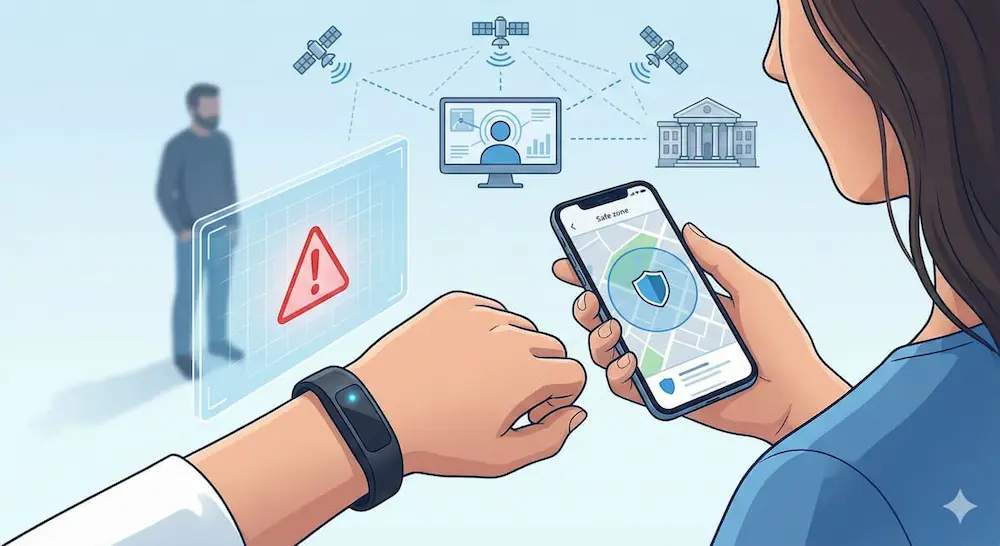
Anti-abuse bracelets (pulseras antimaltrato) are electronic monitoring devices that a judge can order to supervise a restraining order in real time. The accused wears a bracelet and carries a tracking phone; the victim has a device with alerts and an SOS button. They are monitored round the clock by the Cometa Centre. Tampering with them, not wearing them or letting the battery run down is a criminal offence (art. 468.3 of the Criminal Code).
If you have been told about the bracelet because you have a restraining order in your favour, or because the court has imposed one on you, it is normal to have questions: how it works, what happens if an alarm goes off, what happens if it fails. All the more so after the news reports about problems with the system published since 2025. Here we explain it rigorously, separating what the law says from what has come to light through official sources and the press.
What they are and what they are for
The official name is the System for electronic monitoring of compliance with restraining measures and penalties (Sistema de seguimiento por medios telemáticos del cumplimiento de las medidas y penas de alejamiento), which comes under the Ministry of Equality. It is not a stand-alone measure: it serves to monitor compliance with a restraining order already made by a judge, so that any approach is detected immediately. It is particularly useful against post-separation harassment, when the abuser does not accept the break-up.
It is used in gender violence cases and, since Organic Law 10/2022, in sexual violence cases as well. The current operating protocol, updated in March 2024, provides for its use both for interim measures and for penalties, supervised release or the conditions attached to a suspended sentence. Its ultimate purpose is to prevent the most serious cases; the figures are in our article on femicide in Spain.
Who decides whether one is fitted
It is always ordered by a judge or court by means of a reasoned decision. During the investigation stage in Alicante, this will normally be the Violence against Women Section of the Alicante Court of First Instance (Sección de Violencia sobre la Mujer del Tribunal de Instancia de Alicante), formerly known as the Violence against Women Court and restructured by Organic Law 1/2025. The legal basis is found in:
- Article 64.3 of Organic Law 1/2004 (Ley Orgánica 1/2004): allows the court to order “the use of instruments with the appropriate technology” to verify immediately any breach of the restraining order.
- Article 544 bis of the Criminal Procedure Act (Ley de Enjuiciamiento Criminal, LECrim): for interim measures and, expressly, for sexual violence offences.
- Article 48.4 of the Criminal Code (Código Penal): for monitoring restraining penalties imposed in a judgment.
It is not automatic. The judge assesses the risk to the victim, the seriousness of the facts and technical feasibility (for example, network coverage in the area). It is usually ordered together with a protection order (orden de protección), the urgent hearing for which must be held within a maximum of 72 hours under article 544 ter LECrim.
How they work
According to the protocol published by the Government Delegation against Gender Violence (Delegación del Gobierno contra la Violencia de Género), the system is made up of:
- The accused’s device: a transmitter bracelet that must be worn at all times and a tracking phone linked to the bracelet, with GPS and mobile communication.
- The victim’s device: a tracking phone that warns her if the accused comes near and includes an emergency (SOS) button.
The judge sets exclusion zones, which can be fixed (home, workplace, the children’s school) or mobile, that is, a distance that moves with the victim wherever she is. The Cometa Centre, operational 24 hours a day, every day of the year, receives the signals and acts according to their seriousness:
| Situation | Type | What Cometa does |
|---|---|---|
| Entry into a fixed or mobile exclusion zone | Alarm | Alerts the National Police or Guardia Civil, contacts the victim and informs the court and the Public Prosecutor’s Office |
| Bracelet broken or removed, battery flat | Serious technical alarm | Contacts the parties and, if necessary, the security forces; informs the court |
| Approach to the zone or minor technical incident | Alert | Monitoring and contact to resolve it |
| Victim presses the SOS button | Alert | Contacts the victim, finds out her situation and, if necessary, mobilises the security forces |
Obligations of the person wearing the bracelet
If the court has imposed the device on you, you must:
- Wear the bracelet and keep the tracking phone with you at all times.
- Keep the battery charged and follow the technical instructions given to you when it is fitted.
- Not tamper with, cover, damage or try to remove any part of it.
- Answer calls from Cometa and go to a police station if required to do so to resolve an incident.
- Respect the distance and the zones set at all times, even if the device fails.
The offence of tampering with the device: article 468.3 CP
Article 468.3 of the Criminal Code punishes with a fine of six to twelve months anyone who disables or disrupts the normal operation of these devices, does not carry them, or fails to take the steps required to keep them in proper working order (for example, repeatedly letting the battery run flat).
This is different from breach of the order as such: if you also approach the victim or enter a prohibited zone, article 468.2 provides for imprisonment of six months to one year. And failure to comply with an interim measure may lead the judge to call a hearing to consider more serious measures, including remand in custody (article 544 bis LECrim). We explain this in detail on our page on breach of a restraining order.
From the defence’s point of view, not every alarm amounts to an offence. It is necessary to analyse whether there was intent, whether the incident was technical (lack of coverage, equipment failure) and whether Cometa’s reports are complete and reliable. That analysis is especially relevant in light of what has happened in recent years.
Important: the device is a support tool, not an absolute guarantee. If you are the victim and sense danger, call 112 even if no alert has gone off. If you are the accused and the device fails, report it to Cometa immediately and keep everything in writing: the obligation to keep your distance remains in force.
Problems with the system between 2024 and 2026
These are the facts recorded in official sources and reputable press reports:
- Change of provider and migration (2023-2024): the service, previously managed by Telefónica, was awarded at the end of 2023 to Vodafone, which provides it together with Securitas. The migration of data to the new system was completed in March 2024; according to Maldita.es, there were 4,810 active devices at the time.
- Public Prosecutor’s annual report (September 2025): the State Attorney General’s Office (Fiscalía General del Estado) stated that the Cometa Centre could not provide information from before 20 March 2024, which reportedly led to provisional dismissals and acquittals in breach proceedings because that evidence was missing.
- Response from the Ministry of Equality (18 September 2025): it acknowledged “isolated technical incidents” during the migration, stated that they had been resolved by the end of 2024 and maintained that the devices protected victims at all times and that the dismissed cases could be reopened once the data had been recovered.
- Court of Auditors (January 2026): the Court of Auditors (Tribunal de Cuentas) included the management of these devices in its 2026 audit programme, as reported by Infobae.
- New contract (2026): on 27 January 2026 the Council of Ministers authorised a new 36-month contract worth between 71.4 and 111.1 million euros. The Ministry announced devices worn on the ankle, longer battery life and a non-removable SIM card. Following an extension of the previous contract, in May 2026 it was again awarded to the joint venture formed by Vodafone and Securitas, according to the financial press.
What does this mean for you? If you are a victim, it is advisable not to rely solely on the device and to report any anomaly. If you are under investigation for breach, your defence should request and examine Cometa’s complete technical records for the specific period, because the reliability of that data is an issue the courts have already had to assess.
Practical tips if you are the protected person
- Always keep the device charged and with you, including at home.
- If you receive an alert, follow Cometa’s instructions and get to safety.
- Note the date and time of any incident, approach or failure.
- Ask the victim support service about other complementary resources, such as the ATENPRO support and protection service.
- If the accused approaches you by other means (messages, third parties), this may also be a breach: keep it as evidence. Our evidence guide will help you.
Frequently asked questions
Who decides whether an anti-abuse bracelet is fitted?
Always a judge or court, by means of a reasoned decision, normally the Violence against Women Section of the Court of First Instance. It can be ordered as an interim measure during the investigation, as part of a protection order, or in the judgment to monitor a restraining penalty. Neither the police nor the victim can impose it themselves, although they can request it through the Public Prosecutor’s Office or the victim’s lawyer.
What happens if the bracelet’s battery runs out?
A technical alarm goes off at the Cometa Centre, which will contact the wearer so that the problem is resolved. If the battery has run down because it was not charged as required, this may constitute the offence under article 468.3 of the Criminal Code, punishable by a fine of six to twelve months. That is why it is important to follow the charging instructions strictly.
Does the bracelet replace the restraining order?
No. The device only serves to monitor compliance with a restraining order that already exists. If it fails or has not been fitted, the order remains in force and failing to comply with it is a breach, punishable by imprisonment of six months to one year when the victim is the partner or former partner, under article 468.2 of the Criminal Code.
Are the bracelets being replaced by ankle tags?
In January 2026 the Ministry of Equality announced that the new contract includes devices worn on the ankle, with a longer-lasting battery and a non-removable SIM, to make tampering more difficult. The contract was awarded in May 2026. If you already wear a device or are protected by one, the Cometa Centre will inform you of any replacement.
Whether you need protection or a device has been imposed on you and you want to understand your obligations or defend yourself against an accusation of breach, we can help you. See our page on restraining orders in gender violence cases (órdenes de alejamiento) or call us on 607 449 491, available 24 hours a day.
Legal basis and sources
- Criminal Code, article 468 (BOE, in Spanish)
- Criminal Code, article 48 (BOE, in Spanish)
- Organic Law 1/2004, article 64 (BOE, in Spanish)
- Criminal Procedure Act, articles 544 bis and 544 ter (BOE, in Spanish)
- Government Delegation against Gender Violence: electronic monitoring devices (in Spanish)
- Operating protocol for the electronic monitoring system (March 2024, in Spanish)
- Ministry of Equality: press release of 18 September 2025 (in Spanish)
- Maldita.es: what we know about the failures of the electronic bracelets (in Spanish)
- Infobae: the Court of Auditors will audit the management of the bracelets in 2026 (in Spanish)
- Telemadrid: the new bracelets will be worn on the ankle (27/01/2026, in Spanish)
- Mundiario: the Ministry of Equality awards the contract to Vodafone again (13/05/2026, in Spanish)