


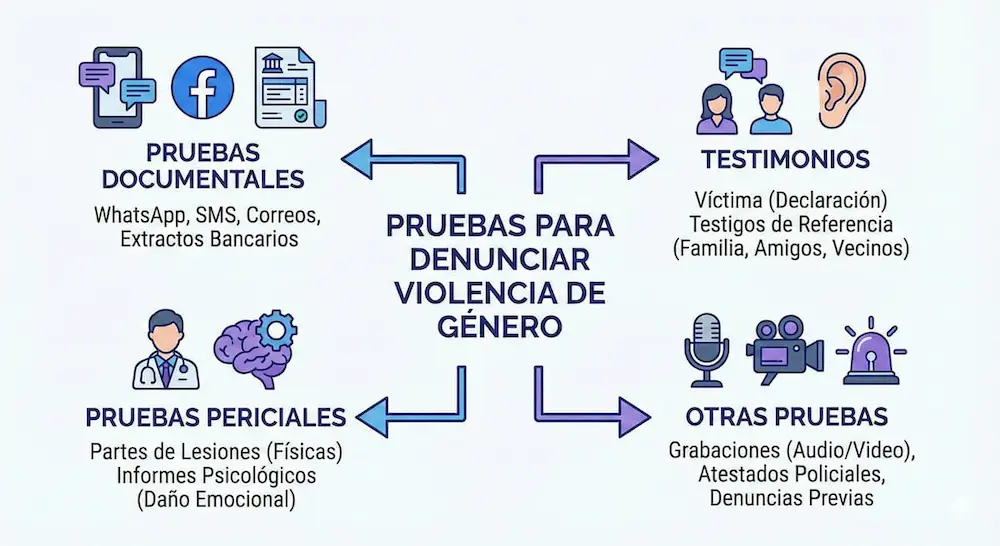
To prove gender violence in Spain, your own statement can be enough if it is credible, plausible and consistent over time, but it becomes much stronger with corroboration: medical injury reports, messages kept on the original phone, recordings of conversations you took part in, witnesses, and psychological or forensic reports. You do not need to have everything before reporting: the investigation also looks for evidence.
One of the questions we hear most often at our office is: “What if they don’t believe me?” It is an understandable fear, because violence between partners usually happens at home, with nobody else present. The good news is that the Spanish justice system has clear criteria for assessing these cases, and much of the evidence can be gathered and kept calmly and without putting yourself at risk. In this guide we explain what that evidence is, how much weight it carries and how to keep it safe.
Your statement as incriminating evidence
For decades the Supreme Court (Tribunal Supremo) has accepted that the victim’s statement can be sufficient incriminating evidence (prueba de cargo) for a conviction, even when it is the only direct evidence. To reach that conclusion, the court tests it against three parameters:
- No subjective lack of credibility: there must be no ulterior motives (revenge, financial interest, prior resentment) that would explain the accusation.
- Plausibility: the account must be logical and supported by external facts, known as peripheral corroboration (an injury, a message, a neighbour who heard shouting).
- Persistence in the accusation: the essential parts of the account must remain the same throughout the proceedings, without significant contradictions.
The Criminal Chamber of the Supreme Court has itself clarified, for example in judgment STS 119/2019, that these criteria are not requirements for validity but reference points that help the judge assess credibility, and that a victim of gender violence is a qualified witness whose statement is assessed by the court that hears it first-hand.
In practice, this means it is best to describe the events in as much detail as possible (approximate dates, places, exact words), without exaggerating or filling in what you do not remember. Saying “I don’t remember exactly” is much better than contradicting yourself later.
Medical injury reports and medical records
If you have suffered a physical assault, go to A&E or your local health centre even if the injuries seem minor. The medical staff will issue an injury report (parte de lesiones), which is sent to the court and is one of the strongest forms of corroboration there is.
- Explain to the doctor how the injuries happened; this will be recorded in the report.
- Ask for a copy of the A&E or discharge report.
- Photograph the injuries on the same day and on the following days, with something that shows the date.
- If you also suffer from anxiety, insomnia or panic attacks, say so: psychological harm is documented too.
Messages, WhatsApp and social media
Messages containing insults, threats, controlling demands or apologies acknowledging what happened are very common evidence. But there is an important caveat: in judgment STS 300/2015, the Supreme Court warned that digital conversations can be manipulated and held that, if the other party challenges their authenticity, the burden of proving they are genuine falls on whoever submits them, usually through an expert IT report.
To make sure your messages can withstand a challenge:
- Do not delete anything and keep the original phone that contains the messages.
- Take screenshots that show the sender’s number or profile, the date and the time.
- Export the full conversation from the app itself (not just extracts), so that nobody can claim it has been taken out of context.
- If the case requires it, the conversation can be checked at court with the phone present, certified by a notary or a digital certification service, or analysed by an IT expert.
Audio and video recordings
Recording a conversation that you take part in does not breach the secrecy of communications, according to settled case law of the Constitutional Court (Tribunal Constitucional) since judgment STC 114/1984. That is why an audio recording in which your partner threatens or insults you can be submitted as evidence.
What you must not do is record other people’s conversations, install spyware, access the other person’s phone or email without their permission or place hidden cameras in private spaces. That conduct can be a criminal offence (article 197 of the Criminal Code, Código Penal) and, in addition, evidence obtained in breach of fundamental rights has no effect at trial, under article 11 of the Organic Law on the Judiciary (Ley Orgánica del Poder Judicial).
Important: your safety always comes before evidence. Do not provoke an argument in order to record it, and do not let the abuser find out that you are gathering evidence. If you are in danger, call 112. For information and advice, 016 is available 24 hours a day and you do not need to have reported the abuse.
Direct and hearsay witnesses
Witnesses provide independent corroboration of your account. They may be:
- Direct witnesses: people who saw an assault or heard shouting and blows (neighbours, relatives, colleagues).
- Hearsay witnesses (testigos de referencia): people you told about what happened or who saw you arrive in tears or injured. They do not replace a direct witness, but they strengthen the persistence and plausibility of your account.
- Police or Guardia Civil officers who attended the home and describe what they saw.
You will find a detailed explanation in our article on the role of witnesses in gender violence cases.
Psychological, social and forensic reports
Psychological violence leaves its mark, even if it cannot be seen. It can be proved with:
- Reports from your psychologist, from specialist women’s support services or from the social services that have assisted you.
- Reports from the forensic doctor (médico forense) or from the comprehensive forensic assessment units, which the court may order to assess psychological harm and the family situation.
- The police risk assessment carried out when you file the complaint.
If what you are suffering is mainly control, humiliation or isolation, we recommend reading psychological abuse: legal consequences and how to prove it.
Summary of evidence and how to keep it
| Evidence | What it proves | How to keep it |
|---|---|---|
| Injury report | Physical assault and its date | Ask for a copy; the original goes to the court |
| Photographs | Injuries, damage in the home | Copy kept off any shared phone, with the date visible |
| Messages and emails | Threats, insults, control | Do not delete, keep the phone, export the full chat |
| Audio recordings | Threats or insults | Original unedited file, with a backup copy |
| Witnesses | Events or your condition afterwards | Note their name and contact details; give them to your lawyer |
| Psychological reports | Psychological harm, habitual abuse | Keep dated copies |
| Personal diary | Timeline and habitual nature of the abuse | Written at the time, kept in a safe place |
How to keep evidence without putting yourself at risk
- Use a new email or cloud storage account, with a password your partner does not know, and turn on two-step verification.
- Check whether you share your location, email or cloud storage with the abuser, and switch this off when it is safe to do so.
- Send copies to someone you trust or directly to your lawyer.
- Keep a dated diary of each incident: what happened, where, and who was there. It helps to prove that the abuse was habitual.
- Do not wait until you have “enough evidence” to ask for help. A complaint opens an investigation, and the court can order steps that you cannot take yourself.
Bear in mind that, since Organic Law 1/2025 came into force, these cases are investigated by the Violence against Women Section of the Court of First Instance (Sección de Violencia sobre la Mujer del Tribunal de Instancia), formerly the Violence against Women Court (Juzgado de Violencia sobre la Mujer). In Alicante, this is the Violence against Women Section of the Alicante Court of First Instance.
If you are the one who has been reported
The rules on evidence apply to both parties. The presumption of innocence requires the prosecution to rely on valid evidence, and the court must give reasons for believing or not believing each statement. If you have been reported, also keep your full messages, location data, witnesses and any document that contradicts the account, and do not contact the complainant if there is a restraining order in place. If you suspect that a screenshot has been manipulated, you can challenge it and request an expert report. We explain this in how to prove your innocence against a false accusation and on our page on defending men in domestic violence cases.
Frequently asked questions
Can someone be convicted on the victim’s statement alone?
Yes. The Supreme Court accepts that the victim’s statement can be sufficient incriminating evidence even when there is no other direct evidence, provided the court finds it credible after testing it for the absence of ulterior motives, the plausibility of the account and its persistence. Even so, any external corroboration, such as a medical report or a message, greatly strengthens your position.
Are WhatsApp screenshots valid evidence?
Yes, but they are vulnerable if the other party challenges them. In that case, whoever submits them must prove they are genuine, usually with the original phone, a check at court or an expert IT report. That is why it is essential not to delete the conversation, to keep the device and to export the full chat as well as taking screenshots.
Is it legal to record my partner without them knowing?
It is legal to record a conversation that you take part in, even if the other person does not know, and it can be submitted as evidence. It is not legal to record conversations between other people, access their phone or install spy apps. That may constitute an offence against privacy, and the evidence would be excluded at trial.
Do I need evidence before I report?
No. You can report with your account of events and provide whatever you have afterwards. The police and the court investigate, take statements from witnesses, request medical and forensic reports and can order protection measures. The important thing is to be precise and honest, and to keep anything that may be useful later. When you report, you can also apply for a protection order, which the court must decide after an urgent hearing within a maximum of 72 hours.
Every case is different, and the way evidence is presented makes all the difference. If you are thinking about reporting or are already involved in proceedings, our page on defending women who are victims of gender violence explains how we support you, including if you need a restraining order (orden de alejamiento). You can call us on 607 449 491, available 24 hours a day, or write to us from our contact page.
Legal basis and sources
- Criminal Code, article 197 (BOE, in Spanish)
- Organic Law 6/1985 on the Judiciary, article 11 (BOE, in Spanish)
- Criminal Procedure Act, article 710 (BOE, in Spanish)
- Organic Law 1/2004 on Comprehensive Protection Measures against Gender Violence (BOE, in Spanish)
- Organic Law 1/2025 on measures for the efficiency of the Public Justice Service (BOE, in Spanish)
- CGPJ: the Supreme Court sets criteria for social media messages as evidence (STS 300/2015, in Spanish)
- Ministry of Equality: 016 service (in Spanish)